
How community solar can bring reliable, affordable and sustainable electricity to PNG villages, schools, health centres and churches, from consultation to long-term maintenance.
Community Solar Initiatives in Papua New Guinea: A Practical Guide to Reliable, Inclusive and Sustainable Energy
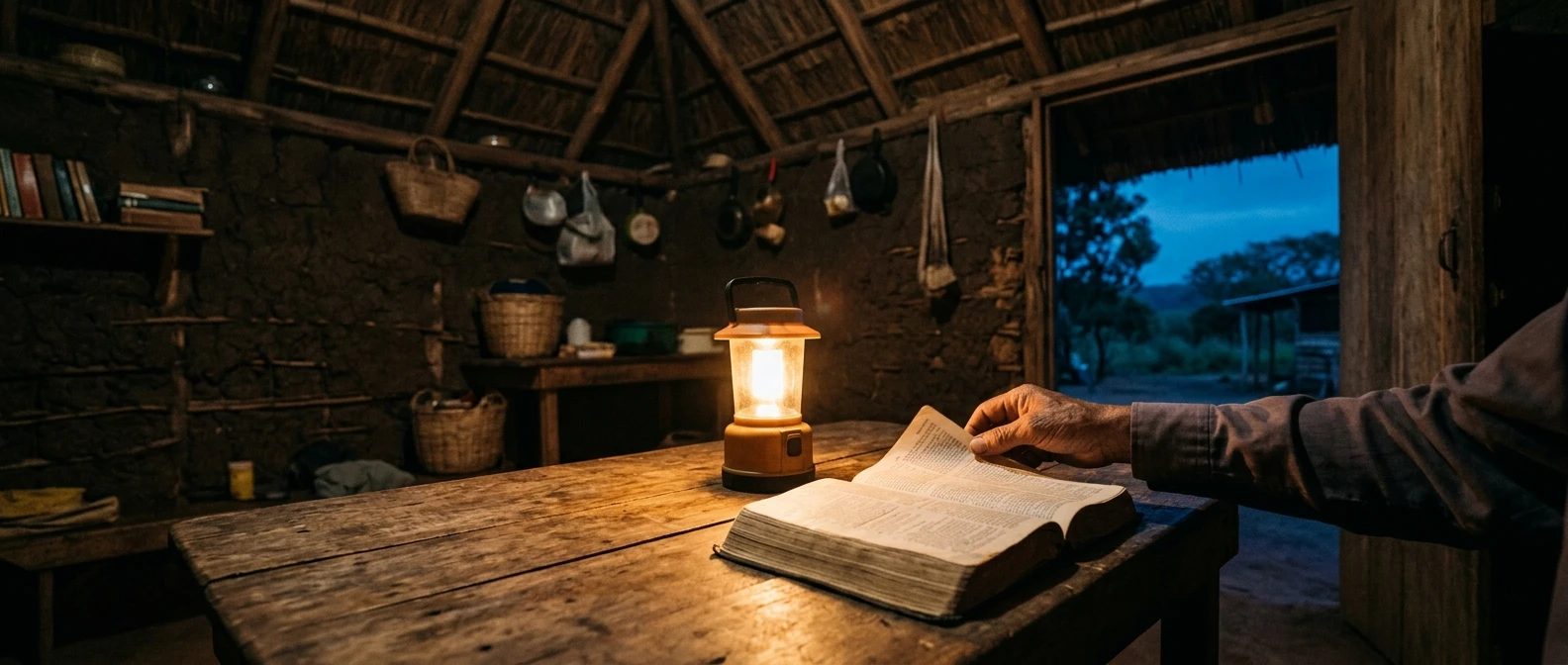
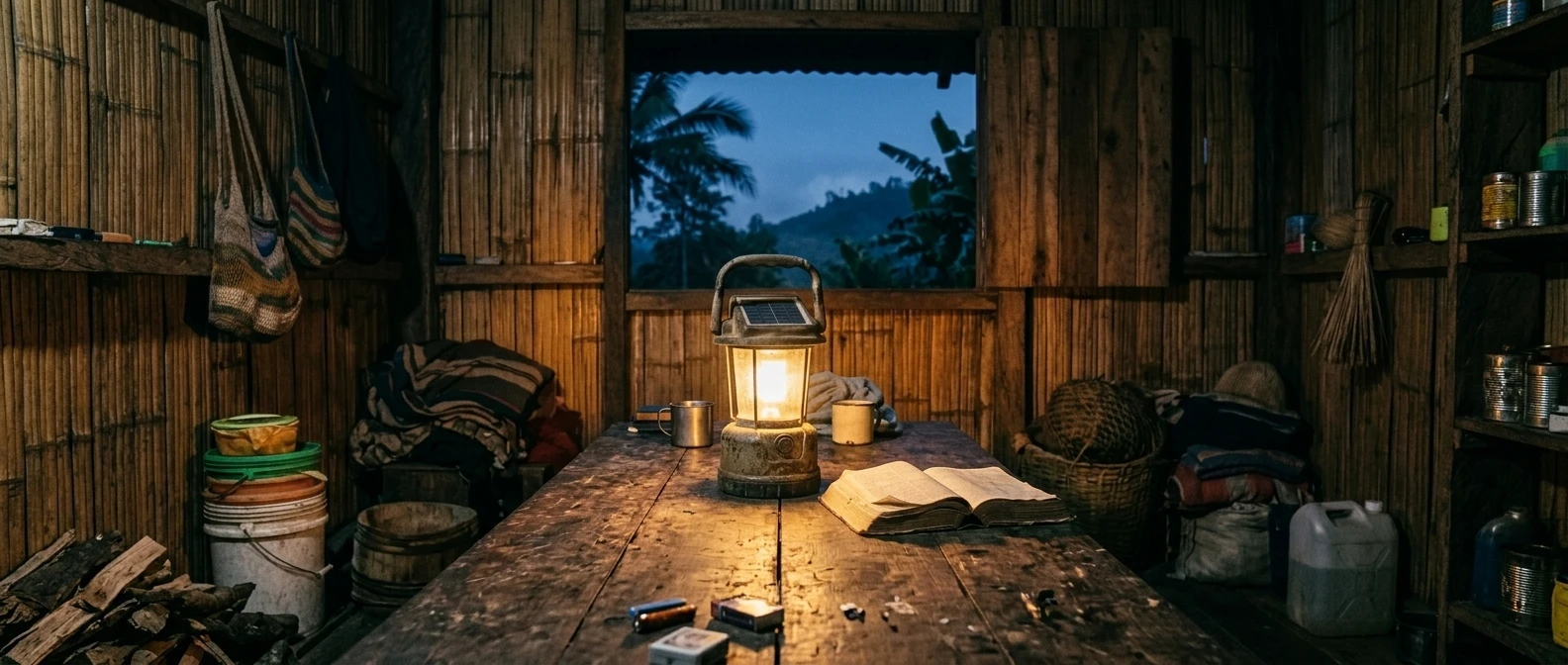
A light in a village home lets a child study after sunset. Refrigeration at a rural health post keeps medicines safe and makes night-time care possible. A charged phone connects a farmer to buyers, a family to relatives, and a community to help in an emergency.
Yet for many people in Papua New Guinea, reliable electricity is still far from guaranteed.
Community solar initiatives in Papua New Guinea can help change that. When they are properly designed, financed, governed and maintained, they become more than an environmental project. They become a practical development tool that supports education, healthcare, livelihoods, safety and resilience.
Why Energy Access Is Still a Challenge
PNG has outstanding renewable resources, including sunshine, water, wind and geothermal energy. But mountains, rivers, forests, scattered villages and hundreds of islands make conventional grid extension slow and expensive.
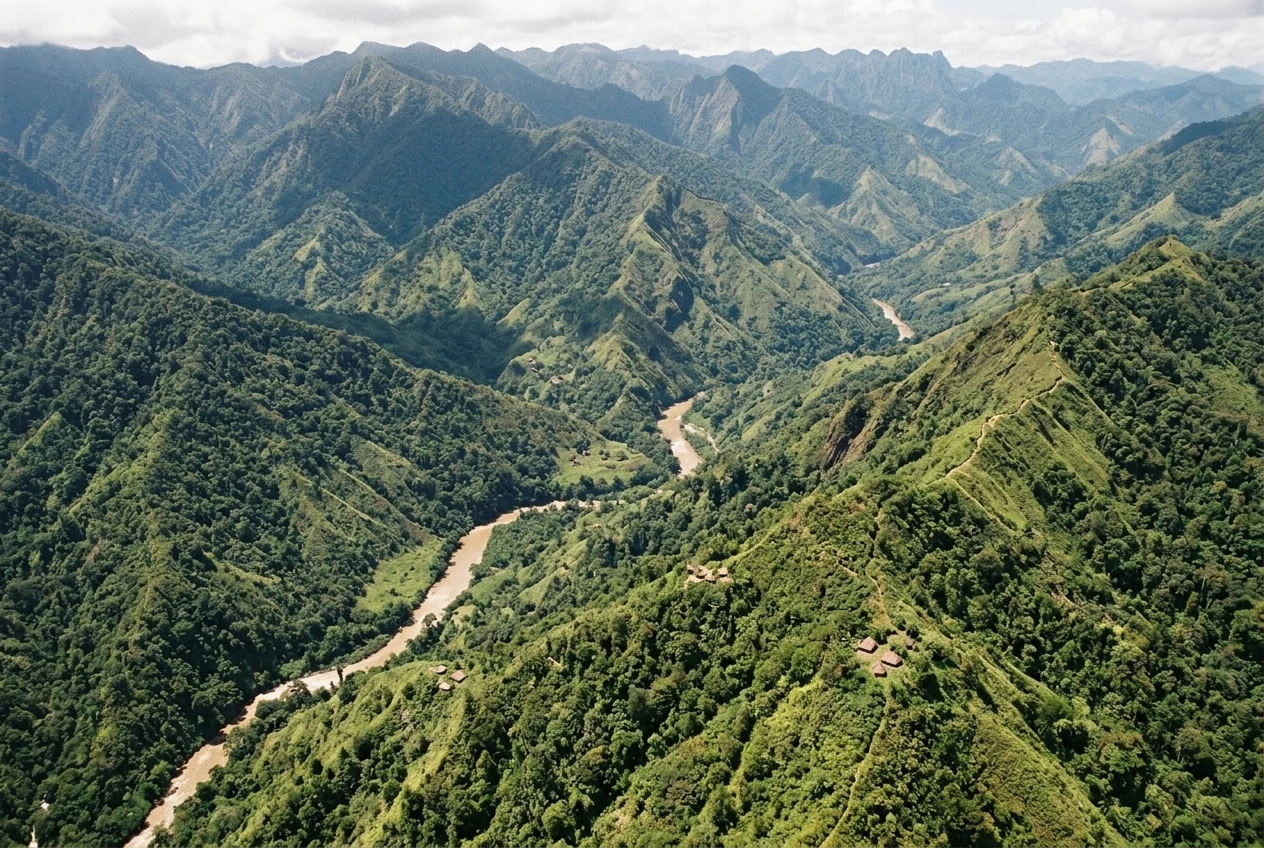
World Bank data show national electricity access has improved, reaching about 43.3% of the population in 2024, but rural access remains lower, at about 39%. The World Bank also points to difficult terrain and widely dispersed communities as the main barriers to grid expansion.
So the challenge is not simply generating electricity. It is building reliable, affordable, locally appropriate systems that communities can actually operate and maintain.
What Is Community Solar?
A community solar project is a shared renewable-energy system serving multiple households, institutions or businesses in a defined community. It might take the form of a solar mini-grid, a shared battery-supported system, or a smaller installation powering priority facilities such as a school, clinic, church or market.
How it differs from other solar options:
- Solar home systems serve one household, which is responsible for its own equipment.
- Utility-scale solar farms feed large electricity networks and need major land, investment and grid infrastructure.
- Community solar is built around shared needs, shared benefits and shared responsibility. Its guiding question is: how can this community get reliable electricity for the things that matter most to its people?
PNG households already rely heavily on decentralised energy. The PNG Energy Survey 2021, analysed by the World Bank, found that off-grid sources account for a large share of household access, with solar lanterns especially widespread. The opportunity now is to move from basic lighting toward systems that can power essential community services.
Who Benefits Most?
Community solar is most valuable where grid power is unavailable, unreliable or uneconomical: remote villages, mountain and island communities, places dependent on diesel generators, and facilities like schools, clinics, markets and churches.
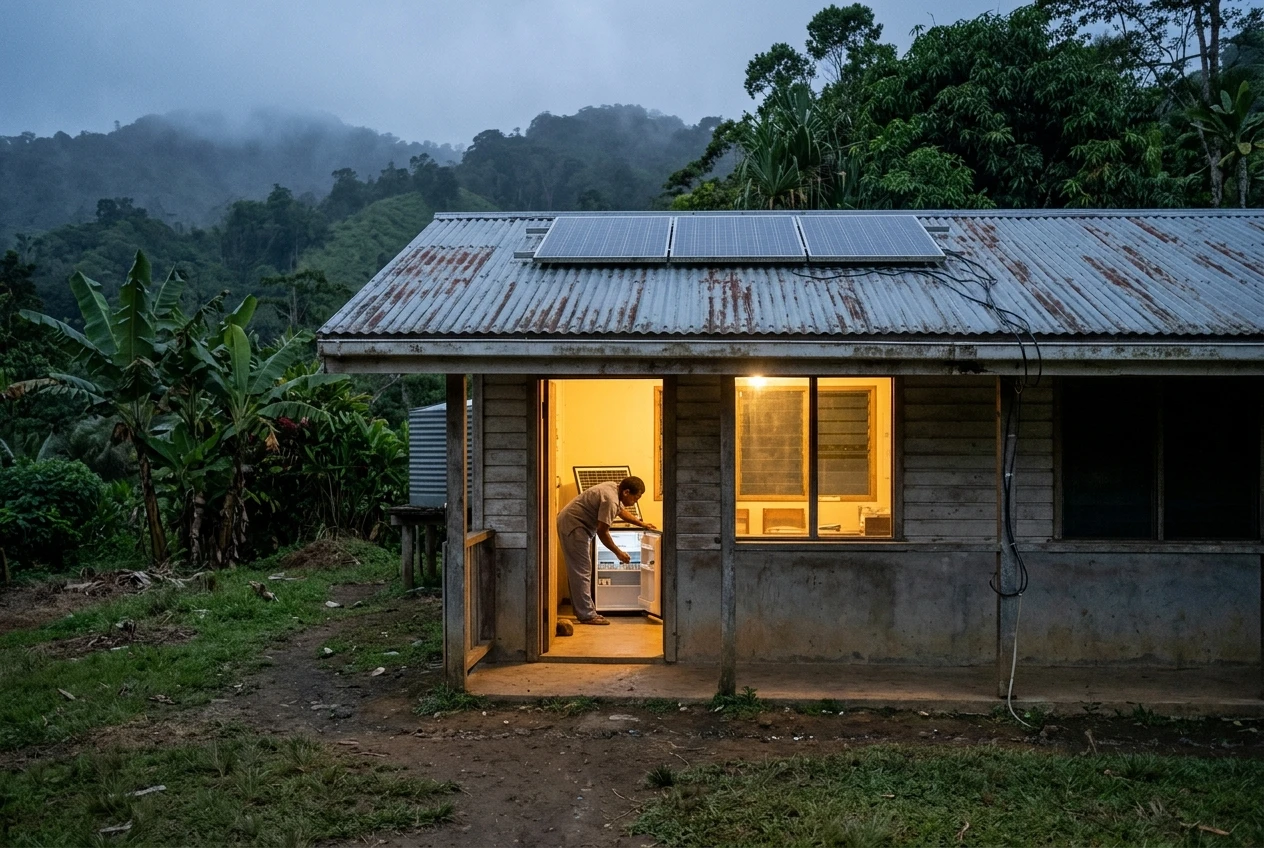
- Women and girls. Refrigeration for a food business, safe lighting at night, phone charging and water pumping all save time and improve safety. Women should have a voice in planning, governance and pricing, not just receive the benefits.
- Students and teachers. Reliable power extends study hours and supports computers, printers, projectors and digital learning.
- Health workers. Clinics need power for lighting, vaccine and medicine refrigeration, sterilisation, communications and emergency care. The key design question is not “How many panels do we need?” but “Which health services must never go down, and what energy do they need?”
- Farmers and fishers. Milling, processing, ice-making, cold storage and market communication can raise incomes, and those incomes can help cover the system’s running costs.
- People with disabilities. Planning should ask who might be unintentionally excluded, and how lighting, communication and assistive technology could help.
The Real Costs: Diesel, Distance and Affordability
Diesel generators have powered many remote facilities, but fuel must be bought, transported, stored, protected and paid for continuously. When prices rise or deliveries are disrupted, the cost of electricity rises with them. Generators also need oil, filters, spare parts and skilled technicians.
Solar changes that equation, because sunlight does not need to be shipped to the village. But solar is not free. Systems still need maintenance, battery replacement, repairs, monitoring, security and administration.
Affordability matters just as much. Many rural households earn irregular, seasonal or subsistence-based incomes, so a tariff built around an urban salary will not work. Options include:
- Low-cost basic connections
- Prepaid or pay-as-you-go payments
- Tiered tariffs
- Subsidies for essential community services
- Productive-use tariffs for businesses
- Grants for capital costs, with users contributing to operations
The right model depends on the community.
From Consultation to Connection: How a Project Works
A good project never starts with “We have panels. Where do we put them?” It starts with: “What does this community need electricity to accomplish?”
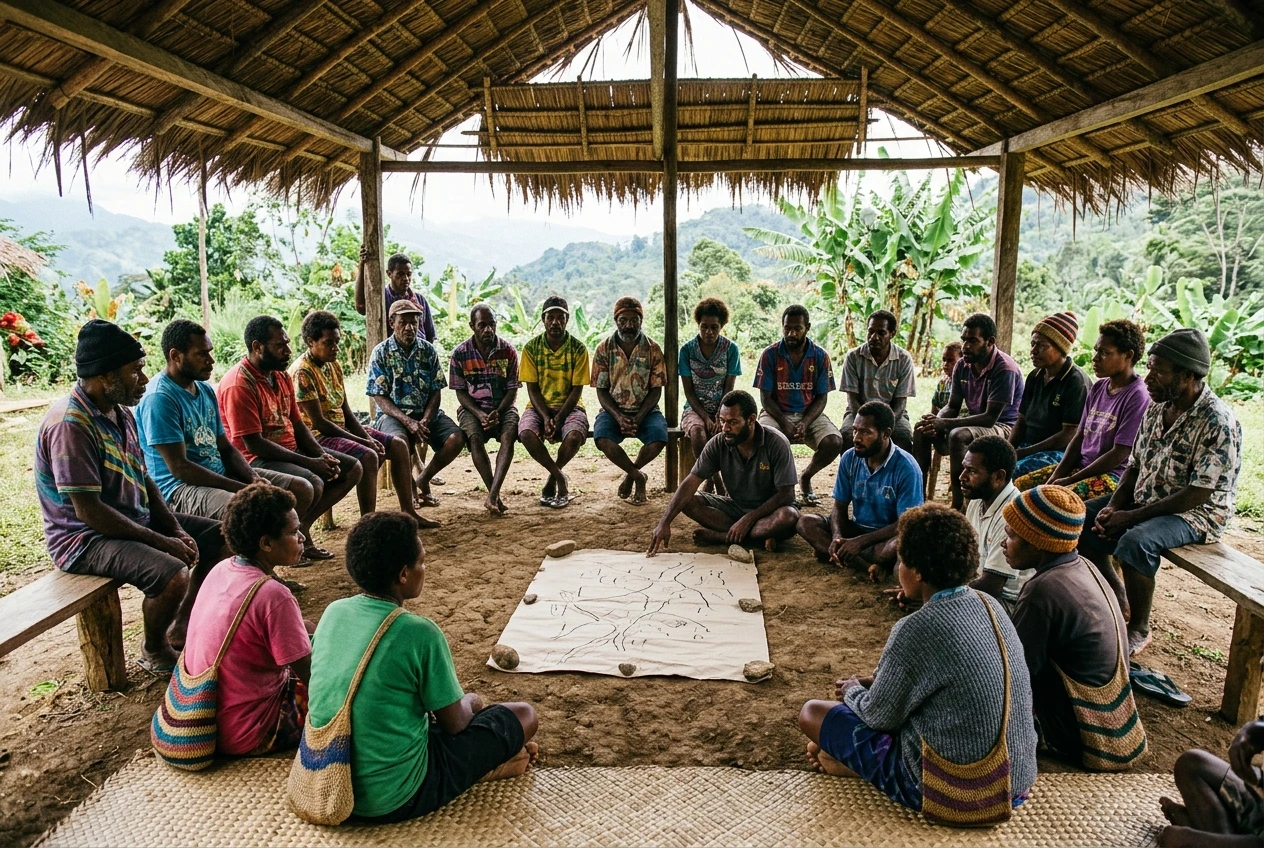
- Consult the community. Meet leaders, landowners, women, youth, teachers, health workers, business owners, church leaders and people with disabilities. Surface priorities and potential conflicts before buying anything.
- Assess energy needs. Document current demand and likely growth. Refrigerators, pumps and computers tend to arrive after the lights.
- Assess the site. Consider solar resource, land ownership, flood risk, drainage, access, security, cable routes and room for expansion.
- Design the system. Size panels, batteries, inverters, controllers, meters, wiring, earthing and protection to actual demand.
- Secure financing. Ask not only “Who pays for installation?” but “Who pays for the batteries five years from now?”
- Install and commission. Use qualified personnel. Treat safety as non-negotiable.
- Train local operators. Cover operation, basic troubleshooting, safety, metering, reporting, customer communication and when to call outside technicians.
- Monitor. Track production, consumption, downtime, battery condition, revenue, maintenance costs and user satisfaction.
A solar project is a long-term service, not an installation event.
Designing for Local Conditions
The right sequence is Need \u2192 Demand \u2192 Design \u2192 Finance \u2192 Equipment, not Equipment \u2192 Installation \u2192 Hope.
- Avoid undersizing. A system that works well at first can be overwhelmed as demand grows, leaving users frustrated and the project with a reputation for unreliability.
- Avoid oversizing. Unused capacity still costs money. Aim for a right-sized system with room for realistic growth.
- Plan for batteries. Consider expected cycles, temperature, depth of discharge, lifetime, replacement cost and local availability. Include replacement in the budget from day one.
- Design for PNG’s climate. Heavy rain, humidity, heat, wind, lightning and flooding affect Highland and island sites differently. Coastal sites need corrosion-resistant hardware. Flood-prone sites need elevated electrical equipment. Remote sites need strong physical security.
- Put efficiency first. LED lighting and efficient refrigerators, pumps and appliances can shrink system requirements and costs significantly.
Financing Fairly and Transparently
Possible sources include:
- Community contributions of land, labour, materials, security, cash or management time, without excluding poorer households.
- Grants from government, development partners, churches, foundations and NGOs, especially for capital costs.
- Government programs. The World Bank supports PNG’s target of 70% electrification by 2030, including off-grid approaches, through its National Energy Access Transformation Project. Community projects should align with national and provincial priorities.
- Development partners for studies, training, equipment and monitoring.
- Impact investment where predictable revenue and measurable social outcomes can be shown.
- Pay-as-you-go models, provided contracts are clear on what users pay, for how long, what happens if payments are missed, and who owns the equipment.
Plan for the whole lifecycle: capital cost, installation, training, maintenance, administration, spare parts, battery replacement, monitoring, security and eventual disposal. Publish tariffs in plain language and share records of income and spending. Transparency builds trust.
Building Local Skills for the Long Term
Installation may take a week. The system should last ten to twenty years, so maintenance deserves more attention than installation day.
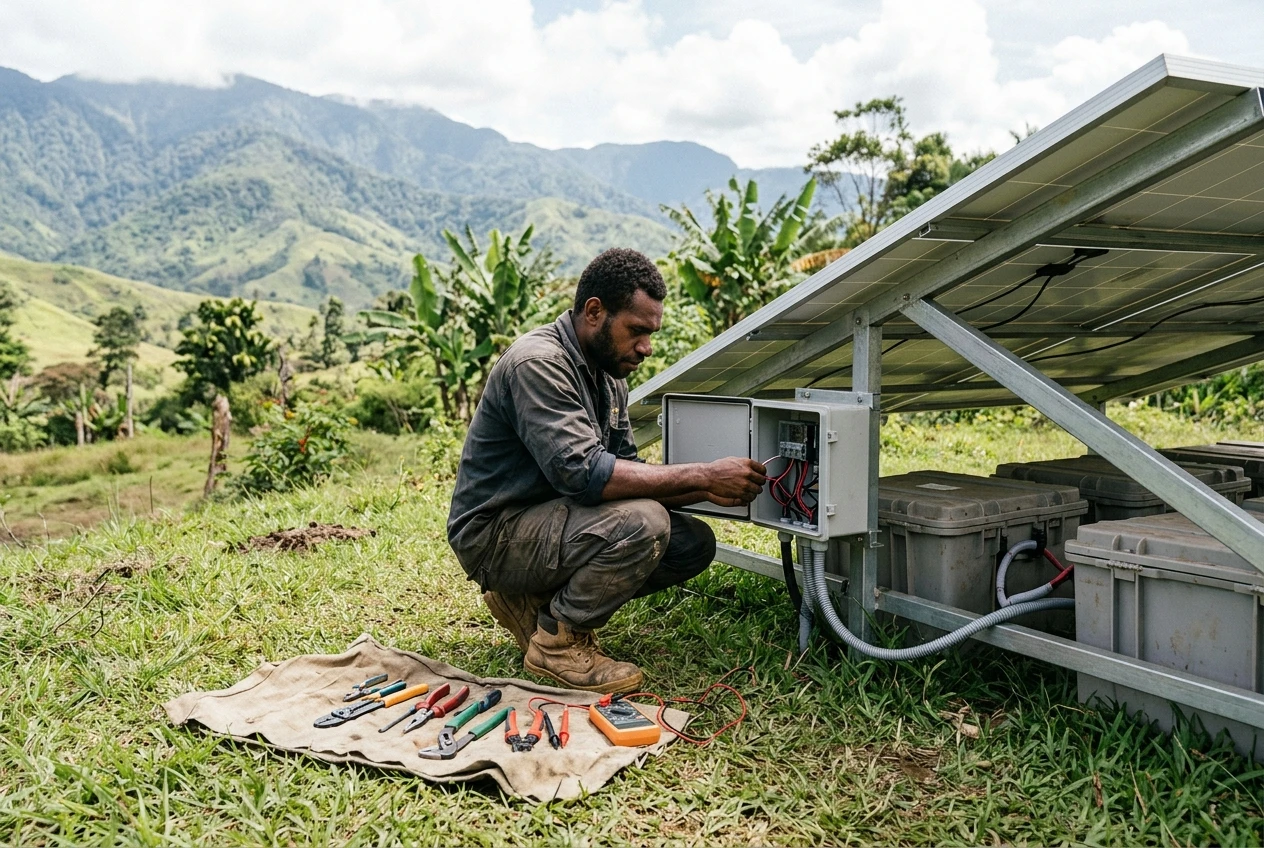
- Train local operators in routine checks, meter reading, recordkeeping and fault reporting, and make sure they know what not to repair.
- Keep a maintenance calendar with routine daily checks, monthly inspections and periodic professional servicing.
- Hold spare parts locally, and record part numbers, suppliers, warranties, installation dates and service contacts.
- Create local jobs for young technicians, apprentices, women in technical roles, bookkeepers and energy managers. The goal is more local capability, not lasting dependence on outsiders.
Why Projects Struggle and How to Measure Success
Too many projects measure success by asking, “Was it installed?” The better questions are: Is power available, and for how many hours? How often does it fail, and how fast are repairs made? Are users paying sustainably? Are women part of decisions? Are study hours, clinic services and incomes improving?
Common reasons projects fail:
- Inadequate consultation
- Unclear ownership
- Weak fee collection
- Poor-quality components
- Unrealistic demand estimates
- No maintenance funding
- Poor after-sales support
- Elite capture, where a small group controls decisions and benefits
- Lack of transparent reporting
Indicators worth tracking:
IndicatorWhat it tells usHours of electricity availableReliabilitySystem downtimeTechnical performanceClinic operating hoursHealth impactStudent study hoursEducation impactBusinesses using electricityEconomic impactRevenue collectedFinancial sustainabilityMaintenance response timeManagement qualityDiesel consumption avoidedFuel savingsWomen in governanceInclusionHousehold connectionsReach
Honest reporting turns setbacks into lessons. If a battery fails early, document why. If tariffs were too low, explain the adjustment. If demand was underestimated, redesign the next project.
A Ten-Step Roadmap for Communities
- Define priority needs. What do we need power for, and which services are most urgent?
- Map stakeholders. Landowners, ward leaders, women, youth, churches, schools, clinics, businesses, authorities and technical partners.
- Assess demand, now and in the future.
- Settle land arrangements for access, ownership, equipment location and expansion before construction.
- Compare delivery models: community-managed, cooperative, NGO-supported, faith-based, social enterprise, public-private or government-supported. No single model fits all of PNG.
- Get qualified technical advice before choosing equipment.
- Examine the financial model. Who pays, who collects, who controls the bank account, who approves spending, and is there a maintenance reserve?
- Establish written governance, such as an energy committee covering finance, operations, customer issues, maintenance, reporting and dispute resolution.
- Train local people before commissioning, not after the first breakdown.
- Monitor and improve, so the first project becomes the learning platform for the next.
Ten questions to ask developers and funders
- Who owns the panels, batteries and electrical infrastructure?
- Who is responsible for repairs?
- How long will the batteries last, and who pays for replacement?
- What does the warranty cover, and where is the nearest authorised service provider?
- How is the electricity price calculated?
- Who controls the project bank account?
- How are disputes about fees, connections or management resolved?
- What happens if demand doubles?
- What happens if the system stops working?
- What happens to batteries and equipment at end of life?
These questions may sound simple, but they decide whether a project serves a community for years or becomes another abandoned asset.
Where Communities Can Find Support
Communities can engage national energy institutions, provincial and local-level governments, reputable NGOs, development partners, renewable-energy companies, technical and vocational institutions, universities, qualified electrical contractors and faith-based organisations with appropriate technical partners. Always do your own due diligence. A project labelled “solar” is not automatically sustainable.
The Future: Fit-for-Purpose Energy Access
PNG does not have to choose one solution. The future mix will likely include national and regional grids, solar mini-grids, home systems, hydropower, battery storage and hybrid systems. A remote island may need a solar-battery mini-grid. A mountain village may do best with decentralised solar. A district centre may eventually connect to the grid. A health facility may need its own resilient system even where neighbouring households have little power.
The guiding principle is fit-for-purpose energy access.
More Than Electricity
The deepest value of community solar is what the power makes possible:
a study light for a child, a refrigerator for a clinic, a phone charger for a farmer, a freezer for a fisher, a computer for a teacher, a lit stall for a market vendor, a lifeline in an emergency, and a first step for a young person starting a business.
The strongest projects will not be those with the most panels. They will understand the people, respect the land, plan for maintenance, train local operators, protect the vulnerable, manage money openly and measure results honestly.
Frequently Asked Questions
What are community solar initiatives in Papua New Guinea? Shared renewable-energy projects that provide electricity to multiple households, businesses, institutions or community facilities, including solar mini-grids, shared solar-battery systems and community-managed systems.
How is community solar different from a solar home system? A home system serves one household. Community solar serves many users and is designed around shared needs, infrastructure and governance.
Can community solar work in remote PNG villages? Yes, particularly where grid extension is difficult or costly. Each project still needs proper technical, financial and community assessment.
Can solar replace diesel generators? Sometimes fully, sometimes partly. Solar with batteries can greatly reduce diesel use, while a hybrid with backup generation may suit other sites.
How much does a community solar project cost? There is no single price. Costs depend on the number of users, energy demand, battery capacity, distribution distance, terrain, transport, equipment quality, security and design. Remote island and mountain projects can have much higher logistics costs.
Who should own the system? Ownership can be community, cooperative, NGO, church, private or public-private. Whatever the model, ownership must be clearly documented.
Who pays for maintenance? This must be agreed before installation. Sources include user tariffs, maintenance funds, grants and service contracts.
How long do solar batteries last? It depends on the technology, temperature, depth of discharge, charging patterns and maintenance. Plan for replacement rather than assuming batteries last indefinitely.
Should communities charge for electricity? Usually some payment is needed for maintenance and replacement, but tariffs should reflect local incomes, with special arrangements for essential community services.
How can women take part? In consultation, governance, financial management, technical training and business opportunities, not only as users.
What happens when equipment breaks? A written maintenance and escalation plan should state who does basic troubleshooting, who does professional repairs and how repairs are funded.
Can churches support community solar? Yes, as partners, hosts, mobilisers, governance participants or facilitators, while technical design, financial management and regulatory requirements are handled professionally.
What is the biggest mistake to avoid? Treating installation as the end of the project. Installation is the beginning. The real test is whether the community still has safe, affordable, reliable power in five, ten or fifteen years.
Build for Decades, Not Installation Day
The story of community solar in Papua New Guinea is not really about panels, batteries and kilowatts. It is about the student who studies after sunset, the health worker who provides safer night-time care, the farmer who reaches buyers, the fisher who keeps a catch fresh, and the family that no longer travels far to charge a phone.
Technology alone is not enough. Lasting projects combine local priorities, community participation, appropriate technology, fair financing, transparent governance, local skills, reliable maintenance, long-term monitoring and genuine accountability.
So the best question is not “Can we install solar panels here?” but:
“Can we build an energy system this community can own, afford, operate, maintain and benefit from for many years?”
When the answer is yes, community solar becomes a pathway to stronger communities, better services, greater opportunity and a brighter future for Papua New Guinea.
Partner With LIGHT PNG
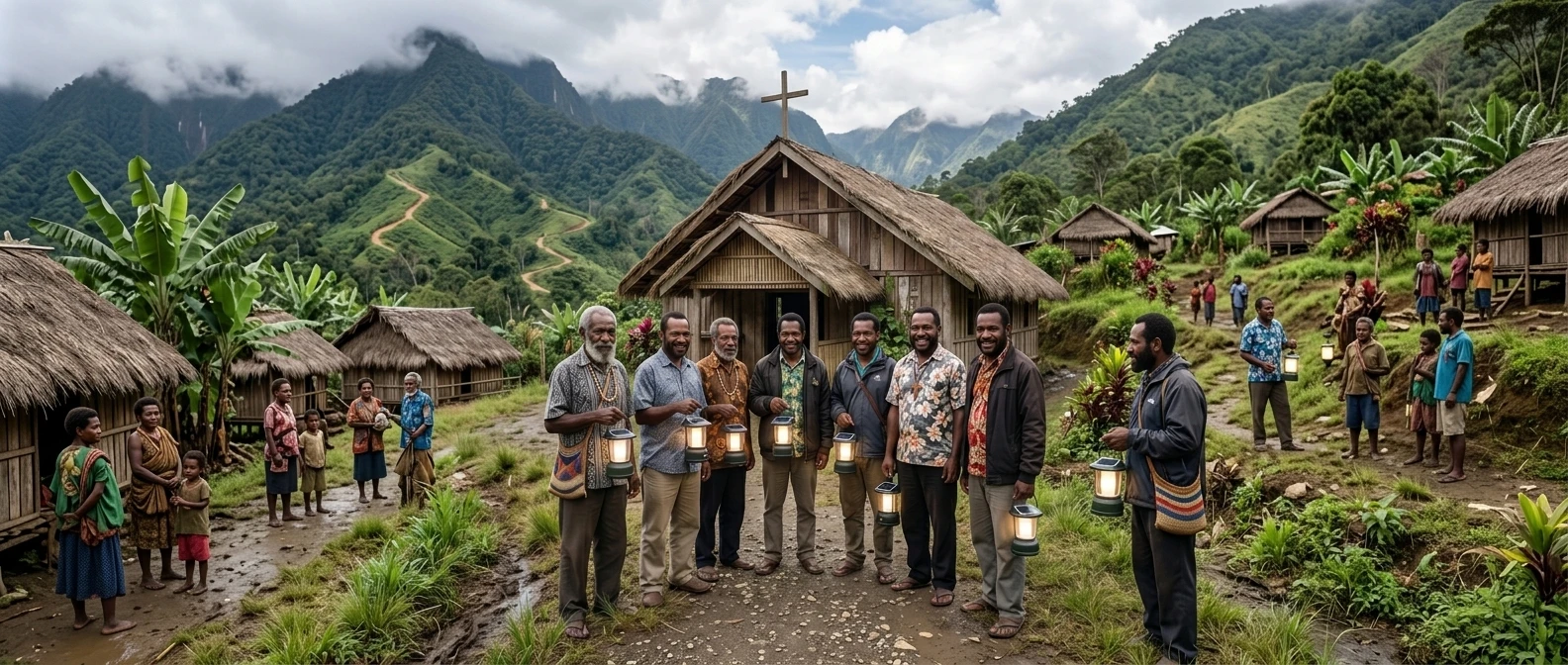
LIGHT PNG is working to bring light to rural churches and communities across the highlands of Papua New Guinea, including solar lanterns for pastors and evangelists serving where there is no electricity. To learn more, pray with us, or support this work, contact us or give today.
Q&A
What is community solar, and how does it work in Papua New Guinea?
Community solar is a shared renewable energy system — such as a solar mini-grid or battery-supported installation — that provides electricity to multiple households, schools, health centres, churches, or businesses in one area, rather than a single home. In PNG, where mountainous terrain and scattered communities make extending the national grid slow and expensive, community solar offers a practical way to deliver reliable power directly to the people and services that need it most.
How is community solar different from a solar home system?
A solar home system powers one household, which owns and maintains its own equipment. Community solar is built around a whole community’s shared needs, infrastructure, and governance, serving multiple households or institutions — like a school, clinic, or church — through a single coordinated system.
Why is electricity access still limited in rural PNG?
World Bank data shows national electricity access reached about 43.3% in 2024, but rural access remains lower at roughly 39%. Mountains, rivers, forests, and widely dispersed island and highland communities make conventional grid extension slow, costly, and often impractical — which is why decentralised solar matters so much here.
Can community solar realistically work in remote PNG villages?
Yes, particularly where grid power is unavailable, unreliable, or uneconomical to extend — including remote mountain villages, island communities, and facilities currently dependent on diesel generators. Every project still needs a proper technical, financial, and community needs assessment before installation.
Can solar power replace diesel generators in PNG?
In many cases, yes. Diesel requires continuous fuel purchases, transport, storage, and spare parts, so costs rise whenever fuel prices or deliveries are disrupted. A solar-battery system can greatly reduce or eliminate diesel dependence, though some remote sites may still benefit from a hybrid solar-generator setup as backup.
How much does a community solar project cost in PNG?
There’s no single fixed price. Cost depends on the number of users, total energy demand, battery capacity, distribution distance, terrain, transport logistics, equipment quality, and security needs — remote island and highland sites typically carry higher logistics costs.
Should rural communities be charged for solar electricity?
Usually some payment is needed to fund ongoing maintenance and future replacement costs, but tariffs need to reflect real rural incomes, which are often irregular or subsistence-based. Models include low-cost basic connections, pay-as-you-go payments, tiered tariffs, and subsidies for essential services like clinics and schools.
Who should own a community solar system?
Ownership can sit with the community itself, a cooperative, an NGO, a church, or a public-private partnership — there’s no single right model. What matters most is that ownership, responsibilities, and decision-making are clearly documented in writing from the start.
Who pays for solar system maintenance and battery replacement?
This needs to be agreed before installation, not after something breaks. Funding typically comes from a mix of user tariffs, a dedicated maintenance reserve, grants, or service contracts, with future battery replacement costs built into the plan from day one.
How long do solar batteries last in community systems?
Lifespan depends on the battery technology, local temperature, depth of discharge, charging patterns, and ongoing maintenance. Rather than assuming batteries last indefinitely, well-run projects budget for eventual replacement from the outset.
What causes community solar projects to fail?
Common causes include inadequate community consultation, unclear ownership, weak fee collection, poor-quality components, unrealistic demand estimates, no dedicated maintenance funding, poor after-sales support, a small group controlling decisions and benefits, and a lack of transparent reporting.
What’s the biggest mistake communities make with solar projects?
Treating installation as the finish line. Installing panels is only the beginning — the real measure of success is whether a community still has safe, affordable, reliable electricity five, ten, or fifteen years later.
How can solar power benefit schools in PNG?
Reliable electricity extends study hours past sunset and supports computers, printers, projectors, and digital learning tools many rural schools currently can’t use. For students and teachers, consistent power can meaningfully improve both access to and quality of education.
How does solar power support rural health centres?
Health posts need dependable electricity for lighting, vaccine and medicine refrigeration, sterilisation, communications, and night-time emergency care. The key design question isn’t how many panels are needed — it’s which health services can never be allowed to go down.
What role can women play in community solar projects?
Women should be involved well beyond simply using the electricity — including in consultation, project governance, financial management, technical training, and the business opportunities reliable power creates, such as refrigeration for food businesses.
Can churches get involved in community solar initiatives?
Yes. Churches can act as partners, hosts, community mobilisers, or governance participants in a project, while leaving technical design, financial management, and regulatory requirements to qualified professional partners.
How is a community solar project actually planned and built?
A good project starts with community consultation and a genuine energy needs assessment, not with buying equipment. From there, it moves through site assessment, system design, financing, installation, local operator training, and ongoing monitoring — treated as a long-term service, not a one-time event.
Does LIGHT PNG support community solar initiatives in Papua New Guinea?
LIGHT PNG works to bring light to rural churches and communities across the Papua New Guinea highlands, including solar lanterns for pastors and evangelists serving areas without electricity. You can learn more, pray for the work, or support it by reaching out directly.
Sources: World Bank, electricity access data for Papua New Guinea; World Bank PNG Energy Survey 2021 analysis; World Bank National Energy Access Transformation Project.